
Solutions of some functional equations in a class of generalized Hölder functions
Maria Lupa
Journal of Applied Mathematics and Computational Mechanics |
 Download Full Text |
 View in HTML format |
 Export citation |
@article{Lupa_2016,
   doi = {10.17512/jamcm.2016.4.12},
   url = {https://doi.org/10.17512/jamcm.2016.4.12},
   year = 2016,
   publisher = {The Publishing Office of Czestochowa University of Technology},
   volume = {15},
   number = {4},
   pages = {105--116},
   author = {Maria Lupa},
   title = {Solutions of some functional equations in a class of generalized Hölder functions},
   journal = {Journal of Applied Mathematics and Computational Mechanics}
}
TY - JOUR DO - 10.17512/jamcm.2016.4.12 UR - https://doi.org/10.17512/jamcm.2016.4.12 TI - Solutions of some functional equations in a class of generalized Hölder functions T2 - Journal of Applied Mathematics and Computational Mechanics JA - J Appl Math Comput Mech AU - Lupa, Maria PY - 2016 PB - The Publishing Office of Czestochowa University of Technology SP - 105 EP - 116 IS - 4 VL - 15 SN - 2299-9965 SN - 2353-0588 ER -
Lupa, M. (2016). Solutions of some functional equations in a class of generalized Hölder functions. Journal of Applied Mathematics and Computational Mechanics, 15(4), 105-116. doi:10.17512/jamcm.2016.4.12
Lupa, M., 2016. Solutions of some functional equations in a class of generalized Hölder functions. Journal of Applied Mathematics and Computational Mechanics, 15(4), pp.105-116. Available at: https://doi.org/10.17512/jamcm.2016.4.12
[1]M. Lupa, "Solutions of some functional equations in a class of generalized Hölder functions," Journal of Applied Mathematics and Computational Mechanics, vol. 15, no. 4, pp. 105-116, 2016.
Lupa, Maria. "Solutions of some functional equations in a class of generalized Hölder functions." Journal of Applied Mathematics and Computational Mechanics 15.4 (2016): 105-116. CrossRef. Web.
1. Lupa M. Solutions of some functional equations in a class of generalized Hölder functions. Journal of Applied Mathematics and Computational Mechanics. The Publishing Office of Czestochowa University of Technology; 2016;15(4):105-116. Available from: https://doi.org/10.17512/jamcm.2016.4.12
Lupa, Maria. "Solutions of some functional equations in a class of generalized Hölder functions." Journal of Applied Mathematics and Computational Mechanics 15, no. 4 (2016): 105-116. doi:10.17512/jamcm.2016.4.12
SOLUTIONS OF SOME FUNCTIONAL EQUATIONS IN A CLASS OF GENERALIZED HÖLDER FUNCTIONS
Maria Lupa
Institute of Mathematics, Częstochowa
University of Technology
Częstochowa, Poland
maria.lupa@im.pcz.pl
Received: 17 October
2016; accepted: 15 November 2016
Abstract. The
existence and uniqueness of solutions a nonlinear iterative equation
in the class of  -times
differentiable functions with the -derivative satisfying
a generalized Hölder condition is considered.
-times
differentiable functions with the -derivative satisfying
a generalized Hölder condition is considered.
Keywords: iterative functional equation, generalized Hölder condition
1. Introduction
In [1, 2]
the space  (
( ) of
) of  times differentiable functions with the
  -the derivative satisfying generalized
  -Hölder condition was introduced
and some of its properties proved. In the present paper we examine the
existence and uniqueness of solutions of a nonlinear iterative functional
equation in this class of functions. We apply some ideas from Kuczma [3],
Matkowski [4, 5] (see also Kuczma, Choczewski, Ger [6]), where differentiable
solutions, Lipschitzian
solutions, bounded variation solutions of different type of itrerative
functional equations were investigated.
-Hölder condition was introduced
and some of its properties proved. In the present paper we examine the
existence and uniqueness of solutions of a nonlinear iterative functional
equation in this class of functions. We apply some ideas from Kuczma [3],
Matkowski [4, 5] (see also Kuczma, Choczewski, Ger [6]), where differentiable
solutions, Lipschitzian
solutions, bounded variation solutions of different type of itrerative
functional equations were investigated.
2. Preliminaries
Consider non-linear functional equation
 | (1) |
where  are given and
  is a unknown function.
We accept the following notation:  ,
,  - is the Banach space
of the r-time differentiable functions defined on the interval
- is the Banach space
of the r-time differentiable functions defined on the interval  with values in
  , such that, for some
  ; its r-th derivative satisfies the
following -Hölder condition
; its r-th derivative satisfies the
following -Hölder condition
 |
where a fixed function  satisfies
the following condition (see [1, 2]):
satisfies
the following condition (see [1, 2]):
(Γ)
  is increasing and
concave, γ(0) = 0, is increasing and
concave, γ(0) = 0,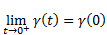 , , 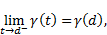  |
We assume that
(i) 
(ii) 
(iii)  fulfils the Lipschitz
condition in
fulfils the Lipschitz
condition in 
(iv) there exists  such that
 , where
  is
the n-th iteration function
is
the n-th iteration function 
(v) is analityc function at  , where is the solution of
equation
, where is the solution of
equation

We
define functions  by the formula
|
|

Lemma 1. [4]
By assumptions (i)-(iii),  defined by (2) are of
the form:
defined by (2) are of
the form:
1. for

 | (3) |
2. for


 | (4) |
where

 | (5) |
and  are of the class
  in I, for all
numbers
in I, for all
numbers  such that
Remark 1.
If (i)-(iii) are fulfilled, then  given by

 |
fulfill -Hölder condition for
 and Lipschitz
condition with respect to
and Lipschitz
condition with respect to  in
in  [
[ . It means, that there
are positive constants
. It means, that there
are positive constants  and
and
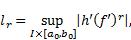 |
such that for  ,
, we have

 . . |
Define the functions  by the following
formulas:
by the following
formulas:
 . . | (6) |
Remark 2.
The functions  defined by (6) fulfill -Hölder condition with respect to variable x in
I and Lipschitz condition with respect to the variable
defined by (6) fulfill -Hölder condition with respect to variable x in
I and Lipschitz condition with respect to the variable  in each
set
in each
set 
Remark 3.
If  satisfy the assumptions
(i)-(iii) and
satisfy the assumptions
(i)-(iii) and  is a solution of
equation (1) then the derivatives
is a solution of
equation (1) then the derivatives  satisfy the system of
equations
satisfy the system of
equations
 |
If assumptions (i)-(iv) are fulfilled and is a solution of
equation (1) in , then the
numbers
 | (7) |
satisfy the system of equations
 | (8) |
where are defined by (2).
Remark 4.
Let  be a solution of the
equation (1). Present
be a solution of the
equation (1). Present  in the following form
 | (9) |
where  and
and 
Define the functions

 |
and for  ,
, 
 |
It follows from above definitions and equation (9) that 𝜓 satisfies the following equation
 |
It is easy to prove, that if assumptions
(i)-(iv) are fulfilled and  are the solution of
equations (8), then the function
are the solution of
equations (8), then the function  satisfies the equation
(1) in
satisfies the equation
(1) in  and the condition (7)
if and only if the function
and the condition (7)
if and only if the function  given by (9) belongs
to
given by (9) belongs
to  and satisfies
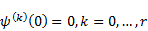 . . |
Thus, we assume that  and consider the equation (1) whose solution satisfies the
condition
and consider the equation (1) whose solution satisfies the
condition
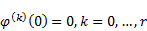 . . |
Then system of equations (8) takes the following form
 |
3. Main result
Theorem 1.
If assumptions (i)-(iii) are fulfilled,  is a monotone function in the interval I, the conditions (iv) and
(v) are fulfilled for
is a monotone function in the interval I, the conditions (iv) and
(v) are fulfilled for 
 and
and
 | (10) |
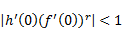 | (11) |
then equation (1) has exactly one solution satisfying the
condition
| . | (12) |
Moreover, there exists a neighbourhood  of the point
  and the number
  such that for a
function
such that for a
function  , satisfying the
condition (12) and the inequality
, satisfying the
condition (12) and the inequality  , a sequence of
functions
, a sequence of
functions
 |
converges to a solution of (1) according to the
norm in the space 
Proof.
From (v) we have  in some neighbourhood of the point
  .
Denote by
.
Denote by  the radius of
convergence of this series. From (11) and from
the continuity of functions
the radius of
convergence of this series. From (11) and from
the continuity of functions  and
and  , from definition of the function there
exists a neighbourhood
, from definition of the function there
exists a neighbourhood  of the point and
  such that
 . . | (13) |
From Remark 1, definition of and from (13) there are positive constants  and
and  , that in
  we have
 . . | (14) |
From Remark 2, definition of there are in  constants
  ,
,  such that
 | (15) |
We accept the following notation:
 | (16) |
 | (17) |
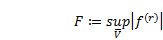 ; ;  is a is a  -Hölder constant
of -Hölder constant
of  in in  | (18) |
 | (19) |
 . . | (20) |
By  we denote the sum of
  for all such that
In view of Lemma 1, we have
 |
and, from (13), we get
 . . | (21) |
Let us take  and
and
 |
Put
|
|
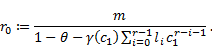
Then let’s take  such that
  and
and



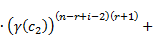



 | (23) |
Choose  . Of course
  . We will select a
neighborhood of zero
. We will select a
neighborhood of zero  such that
  and
and  .
.
Consider the Banach space  with the norm:
 |
Let us define the set
 . . |
Note that  is a closed subset of
Banach space
is a closed subset of
Banach space  and for
  the norm is expressed
by the formula
the norm is expressed
by the formula
|
|

Thus, the set with the metric
ϱ( is a complete metric
space.
is a complete metric
space.
By the mean value theorem and by definition of
the number of c we have for 
 | (25) |
and so 
For define the
transformation  by the
formula
by the
formula
 |
We will show that 
Based on Remarks 1 and 3 the function  belongs to
  from (iv) and (10),
(12) appears that
from (iv) and (10),
(12) appears that  . Then using the
formulas (12), (13), (22), (25) and the assumption (i) we obtain
. Then using the
formulas (12), (13), (22), (25) and the assumption (i) we obtain


 |
Which means from (24) that  . Thus
  .
.
Now we prove that T is a contraction map. Let us
put  ,
,  .
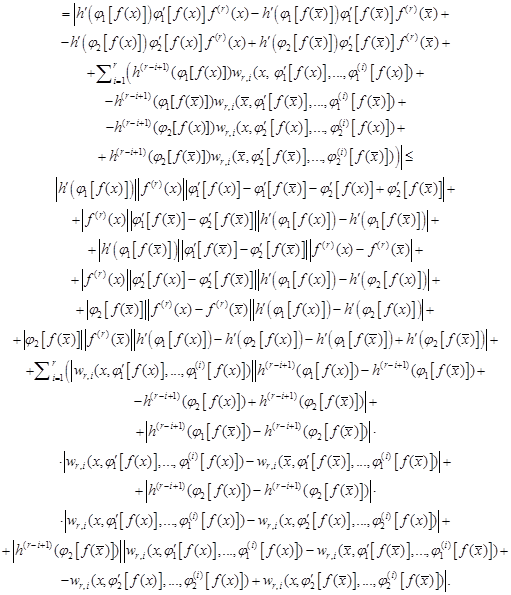
Basing on formulas (4)-(5) of Lemma 1 and from (24) we have
.
Basing on formulas (4)-(5) of Lemma 1 and from (24) we have

 |
Note, that if  , then in view of the
mean value theorem, from
the definition of the number
, then in view of the
mean value theorem, from
the definition of the number  and from (i) we have
the following inequalities
and from (i) we have
the following inequalities
 ; ; | (26) |
 | (27) |
 | (28) |
 | (29) |
By induction on  we
also obtain:
we
also obtain:
 | (30) |
From (v) and by selection of  we have uniform and absolute
convergence of
the series
we have uniform and absolute
convergence of
the series
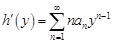 for for  . . |
Let's consider the expression:
 |
From (30) we obtain
 |
Note that a series
 where where  |
converges, because the numbers  have been selected in such a way that
 . . |
Therefore
 | (31) |
Similarly for  we
get
we
get
 | (32) |
By induction and from (26)-(29) we have
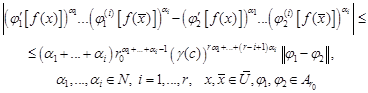 | (33) |
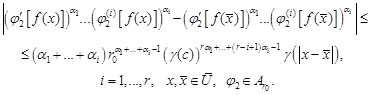 | (34) |
Now from (33) and (34) we get
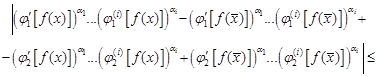
 | (35) |
From (6), by the mean value theorem and from (33) and (34) we get
 | (36) |
Now, from (15)-(22), (27)-(32) and (36) we get
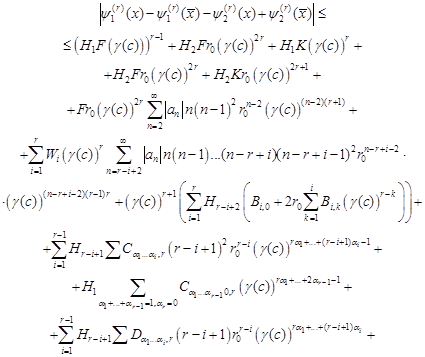
 . . |
Putting  and making use
of definition (24) of the norm in
and making use
of definition (24) of the norm in  we have
 |
which means that  ,
where
,
where  in view on (23).
By the
Banach fixed point theorem, there is exactly one solution  of (1) satisfying the condition (12). This solution is given
as the limit of series of successive approximations.
of (1) satisfying the condition (12). This solution is given
as the limit of series of successive approximations.
 |
where  . This sequence converges in the sense of the norm of
  .
By Lemma 4 in [7], there exists the unique extension
.
By Lemma 4 in [7], there exists the unique extension  of
of  to
the whole interval
to
the whole interval  such that
  for
for  and satisfies the equation (1) in
  . This completes the proof.
Conclusions
In this paper, applying the Banach
contraction principle, a theorem on the existence and uniqueness of  -solutions of nonlinear iterative
functional equation (1) has been proved. The suitable unique solution is
determined as a limit of sequence of successive approximations.
-solutions of nonlinear iterative
functional equation (1) has been proved. The suitable unique solution is
determined as a limit of sequence of successive approximations.
References
[1] Lupa M., A special case of generalized Hölder functions, Journal of Applied Mathematics and Computational Mechanics 2014, 13(4), 81-89.
[2] Lupa M., On a certain property of generalized Hölder functions, Journal of Applied Mathematics and Computational Mechanics 2015, 14(4), 127-132.
[3] Kuczma M., Functional Equations in a Single Variable, PWN, Warszawa 1968.
[4] Matkowski J., On the uniqueness of differentiable solutions of a functional equation, Bulletin de l’Academie des Sciences, Serie des sciences math., astr. et phys. 1970, XVIII, 5, 253-255.
[5] Matkowski J., On the existence of differentiable solutions of a functional equation, Bulletin de l’Academie des Sciences, Serie des sciences math., astr. et phys. 1971, XIX, 1, 19-21.
[6] Kuczma M., Choczewski B., Ger R., Iterative Functional Equations, Cambridge University Press, Cambridge-New York-Port Chester-Melbourne-Sydney 1990.
[7] Lupa M., On solutions of a functional equation in a special class of functions, Demonstratio Mathematica 1993, XXVI, 1, 137-147.
